Inside Aires Community: What Actually Makes This Platform Different
July 7, 2026 · 6 min read
Most crypto trading bot platforms describe themselves the same way: automated, secure, profitable. Those words don't tell you much on their own — every platform in this space uses them. What actually separates one platform from another is the specific mechanics underneath: how the automation really works, what happens when things go wrong, and how much of what's claimed can actually be checked. Here's a real walkthrough of how Aires Community is built, feature by feature.
Five Bots, Not One
Aires doesn't run a single one-size-fits-all strategy. There are five distinct bot tiers — Neuro Core, Quantum Edge, SynapseX, TitanX AI, and Omega Neural AI — each priced as a flat annual subscription and each including a free gas credit on signup. The tiers exist because account sizes and risk appetites aren't uniform. An account connecting a few hundred dollars has different needs than one running institutional-scale capital, and treating both the same way with one strategy would be a worse outcome for almost everyone.
The Gas Wallet: A Fee Model Built to Be Explained, Not Hidden
A lot of trading platforms bury their fee structure in language vague enough that users don't really know what they're paying until they've paid it. Aires uses a mechanism called the Gas Wallet, and it's worth explaining plainly because the mechanics matter.
Your annual subscription includes a free gas credit. As your connected bot generates trading gains, those gains are settled hourly against your Gas Wallet balance. When you top up that Gas Wallet, Aires matches the top-up 2x — which in practice means gains end up splitting roughly 50/50 between you and Aires. If the Gas Wallet balance goes negative, you get a notification to top it up; the bot doesn't stop, but new positions may not be fully managed until it's resolved.
We describe this in detail specifically because we think a fee structure that requires an explanation this long to be honest about is better than a "0% fees!" headline that's hiding something. If you're going to charge for a service, the mechanism should survive being written down.
A Public Leaderboard That Updates While You're Reading It
Most platforms show testimonials. Aires shows a live leaderboard — a rolling sample of real account performance by user ID, showing daily returns as a percentage of tracked capital, next to recently closed trades pulled directly from trading logs with real symbols and real timestamps. No names, no emails, nothing that identifies a person, just numbers that refresh automatically.
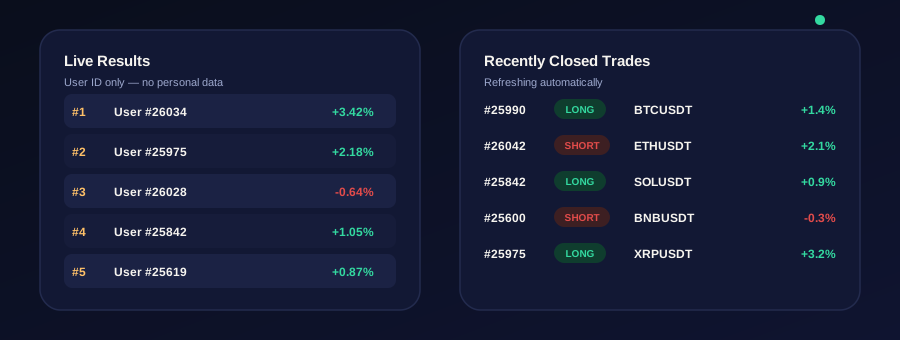
The reasoning here is simple: a testimonial is a sentence someone wrote. A live feed of actual trade outcomes is a dataset someone can watch update in real time. Those aren't the same kind of evidence, and we think the difference should matter more than it usually does in this industry.
No Manual Trading Desk — Four Systems, Not a Team of Humans
Aires is an AI-operated company. There's no discretionary human trader sitting behind an account deciding whether today "feels" like a good day to enter a position. Four automated systems run the platform: one reads market conditions and generates signals, one manages position sizing and stop-logic, one places and manages the actual orders on the exchange, and one powers the live dashboard tracking everything that's happening. The same logic runs every time, without the inconsistency that comes from human fatigue, mood, or overconfidence after a winning streak.
Security Structured Around Not Holding Your Funds
Aires never takes custody of user funds. Every bot operates inside a user's own account on Binance, BingX, or Bybit, connected through an API key that should have withdrawal permissions disabled — a requirement, not a suggestion. The bot can open and close trades and read account activity. It cannot move funds off the exchange. That structural limit matters more than any amount of language about "bank-grade encryption," because it means the worst case if something ever goes wrong with Aires as a company still leaves your assets sitting on your own exchange account, under your own control.
Setup Measured in Minutes, Not a Sales Call
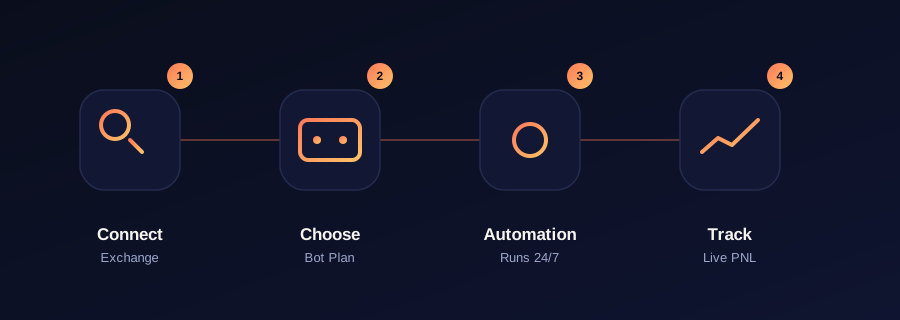
Getting started is: create an account, connect an exchange with a withdrawal-disabled API key, choose a bot plan, and the bot begins managing the account. There's no onboarding call, no manual approval process, no waiting period. The whole point of a fully automated platform is that the automation starts immediately — a slow, manual signup process would undercut the premise before the bot ever places a trade.
Put Together, What This Actually Adds Up To
None of these features exist in isolation — they're built to reinforce each other. The five bot tiers mean pricing actually matches account size instead of forcing everyone into one plan. The Gas Wallet is explained in full because a fee structure that can't survive being written down plainly isn't one worth having. The public leaderboard exists because claims about performance should be checkable, not just stated. And the no-custody security model exists because the biggest risk in this industry has never really been bad trades — it's been platforms holding funds they shouldn't have had control over in the first place.
That's the actual case for Aires: not a single headline feature, but a set of mechanics that were each built to hold up under a direct question about how they really work.